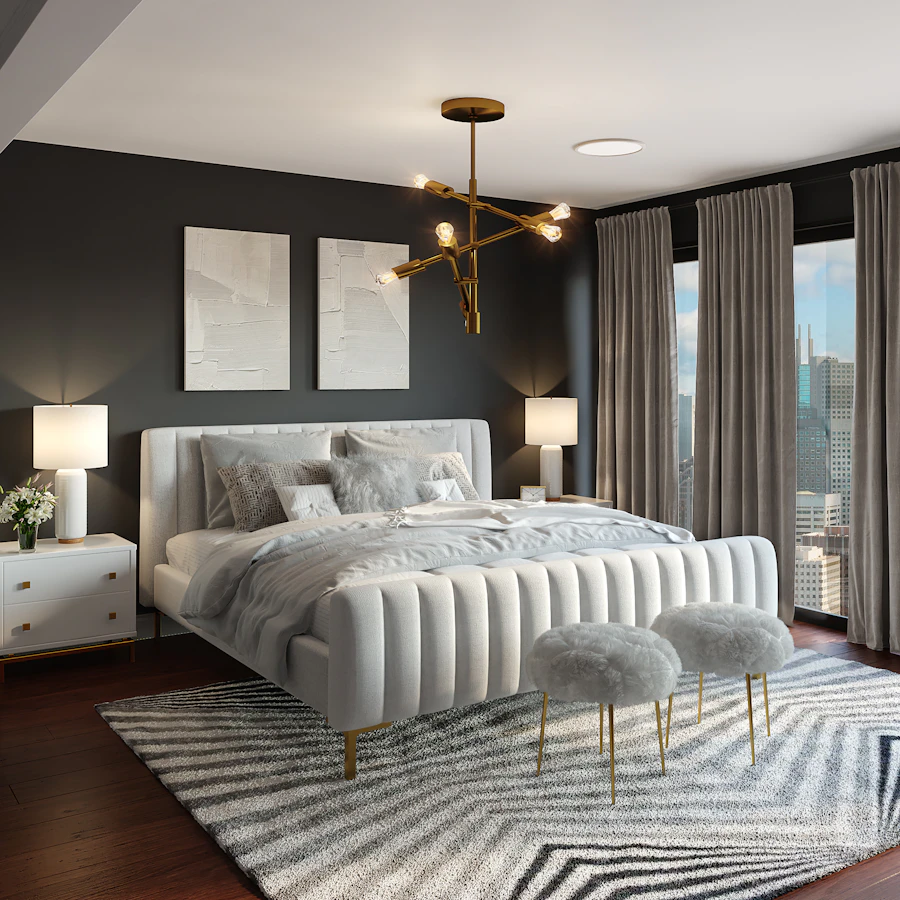


White walls make a small room feel larger only when there is enough daylight to reach the corners. Without it, white turns grey, the corners stay dark, and the eye reads the edge of the room precisely where you were hoping it would not.
In a genuinely dark box (a powder room, a study with one small window, a corridor) the more useful move is the opposite. Take the colour deep enough that the corners disappear into it, carry it across the ceiling and the joinery, and the boundary becomes ambiguous.
Why it works
A room reads as small when you can see exactly where it stops. Remove the contrast between wall, trim and ceiling and there is no line left for the eye to measure against. The room stops announcing its dimensions.
This is also why a small room with white walls, white skirting and a dark floor so often feels cramped. The strongest contrast in the room sits at the one boundary you would rather nobody noticed.
The practical limits
Deep colour needs a light source of its own at eye level: a lamp, a wall light, something other than the ceiling. It also wants a matt or eggshell finish, because anything with a sheen will bounce light and reveal every imperfection in the plaster underneath.
And it needs commitment. A dark wall with white trim is the worst of both approaches. If you are going dark, take the trim, the door and the ceiling with you.
Colour · 22 January 2026
Discuss a Project